
Visible Learning
Why science is always right (even if it's wrong)

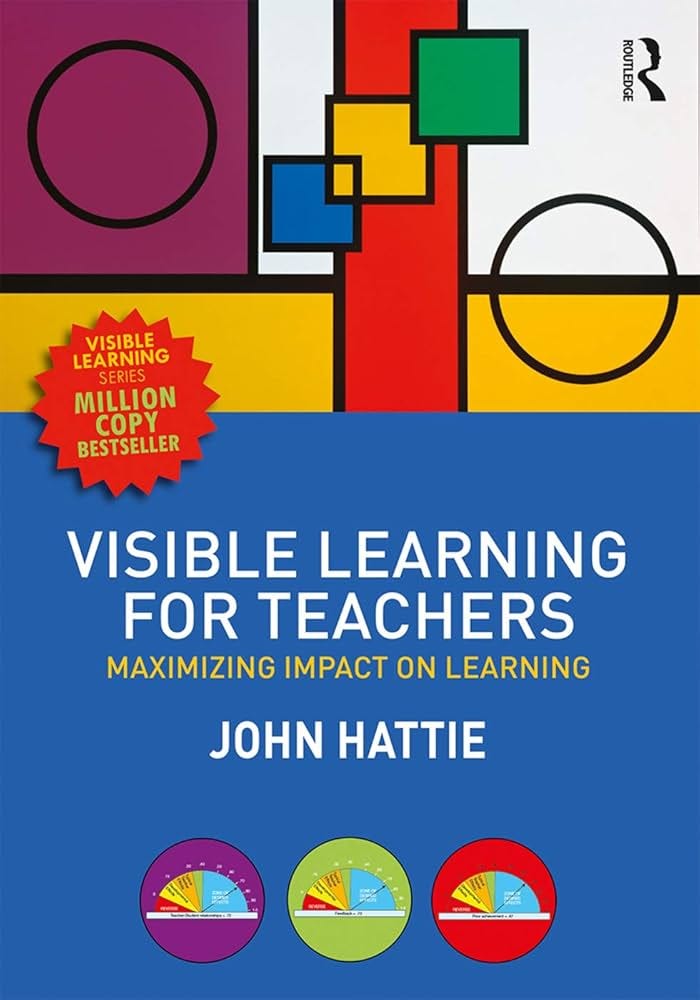
Like many teachers, I bought ‘Visible Learning’ pretty well as soon as it came out. There were claims that it was some form of holy grail for teachers and that it would tell us exactly what worked and what didn’t. The fact that the early effect size tables put feedback as the most effective teacher intervention rang true, and the positioning of metacognitive strategies quite high up was heartening and led me to a ten-year grapple with the subject and a half-written book, ‘Metacognition for Morons’ that I may never finish as I’m too big a moron to work metacognition out (it’s recursive, you see – anyone claiming that it’s easy to conceptualise is lying).
In truth, I was disappointed with both it and myself. I couldn’t understand much of it. Numbers and statistics are not my metier, and I found it a tough trawl to the point of being nearly unreadable. I decided that this was my fault as I just wasn’t clever enough to decode it.
In writing my mystifyingly well reviewed book, ‘Here Endeth the Lesson: The Book of Plenary’, I had cause to go back to ‘Visible Learning’ in order to inform a quite long section titled ‘The Metacognitive Plenary’. I had to read it properly this time, and I delved into Hattie’s analysis of the effect size of various metacognitive strategies. I became more confused. Many of the listed strategies didn’t really seem to be metacognitive, and one, in particular, seemed only useful for teaching someone with profound learning needs how to lay a table. I decided that, again, it was probably the fault of my own brain wiring and that a revered, world famous, peer reviewed, senior academic must have got it right as there are checks and balances in that world, and you’re not allowed to make counter factual claims for money. I put the book and its companion piece on the bookshelf in 2013 and may have only opened it once or twice since.
Enter Stephen Vainker. Stephen is an academic researcher and, like Hattie, a clever man. He first started calling the methodologies in ‘Visible Learning’ into question a couple of years ago and has published a paper provocatively entitled, ‘The Career of John Hattie: Plagiarism, Misconduct and the Coarsening of Education’. I’ve read much of it. Stephen identifies what he believes are 536 episodes of plagiarism and 212 separate data errors. I couldn’t comment on the latter as I don’t understand them, but it does appear that there are sections of Hattie’s work, whether this is inadvertent or sloppy or not, that are direct lifts from the work of others.
There are checks and balances in academia (one would hope). Stephen, on identifying what he felt were academic errors, reported his findings to journals and publishers. As he says, “Clearly, the best place to adjudicate the veracity of my claims is a) the public who have full access, b) the relevant authorities (e.g. UoM).”
I found out last night from a paywalled article in the Herald Sun newspaper that Professor Hattie is now suing Stephen “who he claims trolled him with ‘scandalous’ allegations of plagiarism.” This is serious stuff for a number of reasons. Firstly, it is perhaps deathly serious for Stephen. I would imagine that, with the global success of ‘Visible Learning’, Professor Hattie is not short of a few quid; he’s unlikely to be looking down the sofa for a lost coin. I would also imagine that Stephen might be. Are the courts here being used as a device to stifle academic debate? What are the potential impacts on Stephen’s life if he cannot afford to defend the case? A young man has taken a stand for what he perceives as the truth, and the consequences of his having done so are potentially ruinous for him.
It is serious as well for what it suggests about how we feel about the truth and what this means for education. If Stephen is right, and some of the claims of ‘Visible Learning’ are backed up by false data, then a key text for the evidence-led movement may well be based, in part, on falsehoods. Surely, this is important, and surely it is in the interests of students and the education community as a whole to know if this is the case. If ‘Visible Learning’ is guilty of more than a little academic sloppiness, then, while it does not cast the whole of the science of learning movement into disrepute, it suggests that the foundations of it are built on less concrete foundations than people assert.
I’ve experienced of a version of this myself. My ‘Pedagogy of the Oppressor’ book was turned down by every educational publisher, not because they disliked the text or thought the writing or thinking flawed, but because they were concerned about it being potentially actionable. Another writer has coined the phrase ‘policy entrepreneurs’, which I think a useful term. Could it be that some of these have become so powerful and so wealthy that one is not allowed to disagree with them in public for fear of one’s life and livelihood? Could it be that money is now a tool with which powerful voices might shut down debate? Could it be that the masters of a pedagogic regime can assert their rightness and not have it challenged even in the presence of evidence to the contrary?
There is a battle for the soul and heart of education. This battle goes largely unnoticed by teachers some of whom take the poorly written scripts they are given to deliver, nod meekly and transmit the knowledge. But it is important. If our children are to be subject to pedagogic orthodoxies promoted by those who claim the ownership of some sacred science, then the science has to stand up; otherwise, the whole rationale behind the pedagogic structures is false, and the extrapolations of this science in the classroom are based on flawed thinking.
I am not hopeful for change. The fact that the pedagogic structures contained in another text remains in place and popular when it was been proven in America that the pedagogic regime implemented on its basis caused countless allegations of possibly racist, systematic abuse tends to confirm the old adage that a lie will travel halfway round the world before the truth gets its boots on. Whatever the truth of this, if the case comes to court, and if Stephen can defend it, and if his allegations are proven correct, it won’t change anything. Professor Hattie will no doubt continue a very lucrative career speaking about his research, the same assertions will be made, the same people will defend him, nothing will change aside perhaps from a young man seeking truth having to go through a dangerous and potentially ruinous process. Whatever the truth of this and whether you believe in one side or the other, I feel it is important that educators defend Stephen’s right to speak his truth and, in doing so, defend free speech itself. As Stephen himself says, “the court of law is no place to adjudicate academic disputes.”
This podcast has a researcher who absolutely dismantles the evidence behind the effect sizes used in his research. The following podcast is John Hattie's rebuttal to it, which to me is thoroughly unconvincing. https://open.spotify.com/episode/3EFlXD02mvjuOuXAuTQIAt?si=tmZlp51mRUSARYwHGcBoig
I'm not sure I agree with the premise of the article that Hattie suing in return is authoritarian - either Stephen's claims have valid evidence behind them or not, and if they do then that will be seen in court. Perhaps I am naïve. But it could be a slightly less exciting Wagatha Christie trial.
I’m pretty sure something like “self reported grades” was the biggest effect size, but everyone seemed to latch on to “feedback” and claim that it was the champion. That’s just my bit of feedback on paragraph 1…