

Bowie
Working Class Heroes

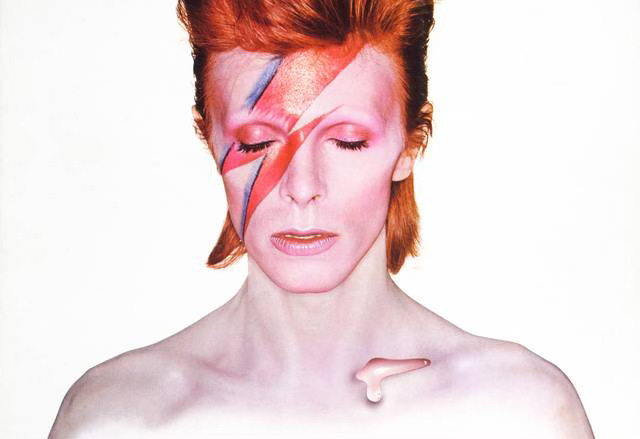
Lennon was not the only working-class musical artist to appear in the BBC’s 100 Great British Heroes[1] from 2002 that so pleased the black community (scandalously, there was not a single black Britain on the list). While Lennon featured at number 8 above Horatio Nelson, Oliver Cromwell, Ernest Shackleton and Captain Cook; his “ex-fiance” McCartney came in bracketed by Queen Victoria and Sir Alexander Fleming at number 18; David Bowie sat between William Wilberforce and Guy Fawkes at number 29; and John Lydon nestled away directly beneath Bongo,[2] the lead singer of that awful, blustering bunch of drab slogan-makers, the U2s, at number 87.
While Bowie was rarely explicitly political, and perhaps the one time he stupidly flirted with fascism in a manner he later excused himself for as “glib, theatrical observations on British society”[3] when in role as the Thin White Duke, it was the worst career error he ever made (and I saw the Glass Spider Tour), he was, for many, their first brush with the idea of there being differing versions of sexuality, and his particular version of masculinity expanded the range of what it was possible for a male to be (in public).
His function as a gatekeeper for other forms of culture was substantial. Referencing Lennon as his “greatest mentor”,[4]Bowie, while speaking at a commencement event at Berklee College of Music in Boston, Massachusetts, outlined his creative process, “What I found that I was good at doing, what I really enjoyed the most was the game of ‘what if?’ What if you combined Brecht/Weill musical drama with rhythm and blues? What happens if you transplant the French chanson with the Philly sound? Will Schoenberg lie comfortably with Little Richard? Can you put haggis and snails on the same plate? … I went on a crusade, I suppose, to change the kind of information that rock music contained.”[5] He then goes on to list his influences: “I adored Coltrane, Harry Partch, Eric Dolphy, Velvet Underground, John Cage, Sonny Stitt. Unfortunately, I also loved Anthony Newley, Florence Foster Jenkins, Jonny Rae, Julie London, The Legendary Stardust Cowboy, Edith Piaf and Shirley Bassey.”[6] He unpacked his combinatory process as revealing to him that “mixing elements of bad taste with good will often produce the most interesting results.”[7]
He “collected ideas, thoughts … they all fed into his life. He would look at one artist, and it would lead him to another artist, which would lead him to a book, which would lead him to a theory, which would lead him to a philosophical text, which would then lead him back to another artist.”[8]
So, any fan following Bowie would encounter the wide range of a sum of influences that were not solely limited to the world of non-classical music (and he was interested not just in presenting things in interesting new ways but in finding new sources of content, also). After his early blues and skiffle efforts, Bowie trained in mime and comedia dell’arte with Lindsey Kemp; his first album, known as the Deram album, was heavily influenced by the music hall artist, Anthony Newley, who, with song-writing partner, Leslie Bricusse, wrote ‘Feeling Good’, made popular by Nina Simone, the theme tune for ‘Goldfinger’ and the set of songs for the original ‘Charlie and the Chocolate Factory’ movie. Many people of my generation would have had their first encounters with Brecht from his televised appearance as ‘Baal’ and their first encounters with the writing of the great Belgian songwriter, Jacques Brel, through Bowie’s cover of ‘Amsterdam’. Through his collaborations and name dropping, Lou Reed and Iggy Pop were brought into the homes of many a ‘rebellious’ suburban youth and, from there, such youth might also investigate the Velvet Underground, John Cale, the Stooges, Mick Ronson and Mott the Hoople’s Ian Hunter whose ‘You’re Never Alone with a Schizophrenic’ is held as seminal by some. Bowie was a remarkable populariser of the non-standard and, culturally, might be thought responsible for generations of dreaming working-class kids having accessed the more literate versions of non-mainstream culture. He was born in Brixton and raised in Bromley. His mum was a waitress. His dad was a promotions officer for Barnados.
[1] 100 Great British Heroes, BBC News, 21st August 2002
[2] Who is not, erm, actually British. This will give you an idea of the almost Trumpian level of intellectual competence of the fans of this act (the word act here has been carefully chosen).
[3] Alan Jones, ‘Goodbye to Ziggy and All That’ Melody Maker (October 1977)
[4] David Bowie, Berklee Commencement Address 1999,
[5] David Bowie, Berklee Commencement Address 1999,
[6] David Bowie, Berklee Commencement Address 1999,
[7] David Bowie, Berklee Commencement Address 1999,
[8] Curator Beth Greenacre in https://www.theguardian.com/music/2021/jan/08/what-five-years-without-david-bowie-has-taught-us